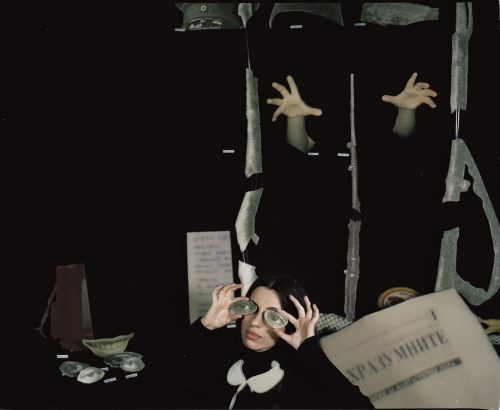
Michel Auder, Trisha Donnelly, Yasmine Anlan Huang, W. Rossen, Zygmunt Rytka
Impossible dreams
Project Info
- 💙 Wschód Warsaw
- 🖤 Michel Auder, Trisha Donnelly, Yasmine Anlan Huang, W. Rossen, Zygmunt Rytka
- 💛 Bartosz Zalewski
Share on

Impossible dreams, exhibition view, Wschód Warsaw
Advertisement


Impossible dreams, exhibition view, Wschód Warsaw

Impossible dreams, exhibition view, Wschód Warsaw

Trisha Donnelly, Astoria 36, 2014, projection of digital image, dimensions variable

Impossible dreams, exhibition view, Wschód Warsaw

Michel Auder, Voyage to the Center of the Phone Line, 1993, Hi8 video and mini dv to digital video SD, colour, sound, video, 00:52:46

Michel Auder, Voyage to the Center of the Phone Line, 1993, Hi8 video and mini dv to digital video SD, colour, sound, video, 00:52:46

Michel Auder, Voyage to the Center of the Phone Line, 1993, Hi8 video and mini dv to digital video SD, colour, sound, video, 00:52:46

Michel Auder, Voyage to the Center of the Phone Line, 1993, Hi8 video and mini dv to digital video SD, colour, sound, video, 00:52:46

W. Rossen, Untitled, 2025, oil on linen, 46 x 35 cm

W. Rossen, Untitled, 2025, oil on linen, 46 x 35 cm

W. Rossen, Untitled, 2025, oil on linen, 46 x 35 cm

Impossible dreams, exhibition view, Wschód Warsaw

Impossible dreams, exhibition view, Wschód Warsaw

Yasmine Anlan Huang, I’ve always been practicing the loss / 我一直在练习失去, 2023, single-channel video installation, color, stereo. 2’10’’

Yasmine Anlan Huang, I’ve always been practicing the loss / 我一直在练习失去, 2023, single-channel video installation, color, stereo. 2’10’’

Impossible dreams, exhibition view, Wschód Warsaw

Zygmunt Rytka, Obiekty Chwilowe - Obiekt Rozpadu, 1988, gelatin silver print on board 48,5 x 59 cm

Zygmunt Rytka, Obiekty Chwilowe - Obiekt Rozpadu, 1988, gelatin silver print on board 48,5 x 59 cm
Reality reveals fractures within perception itself. As Hal Foster suggests, the “surreal” does not arrive from outside but emerges from an intensified engagement with the real - an effect of friction between seeing and materiality. The insistent presence of objects, their repetition and opacity, complicates the world, exposing a logic that operates alongside everyday experience. In this view, surrealness becomes an immanent consequence of perception: a moment when the real ceases to be self-evident and begins to function as a condensed, autonomous structure.
An excess of reality shifts the gaze from pure fascination toward materiality, within which the surreal reveals itself from inside the real. Impossible Dreams uncovers the unobvious possibilities of the ordinary, restoring objects to their complexity and their potential for magical agency, eliciting both aesthetic and cognitive astonishment. Reality becomes indistinguishable from its representations, and the works in the exhibition expose con- vergences between the real and the unreal. It is precisely through rigorous investigation, repetition, and sustained attention to material that the hidden layers of objects and images emerge – those that usually remain beyond the reach of everyday experience.
The video Voyage to the Center of the Phone Lines by Michel Auder (b. 1945, France) is grounded in a hyperrealist recording of reality that, under the artist’s camera, reveals unsettling layers. The work draws from seemingly banal situations moments of disjunc- tion, accidental gestures, and tensions in which everyday life begins to behave like dream material. The camera becomes a tool for observing the social unconscious, registering the world as it is – until it starts to resemble a surrealist narrative.
Trisha Donnelly (b. 1974, California) continues to explore this boundary, oscillating between the concrete and the abstract, in accordance with—and in defiance of—materiality itself. In Astoria 36 (2014), form and medium relinquish their presumed functions. The work’s reality reveals itself only through attentive observation; it simply is what it is and does not exist solely within the visual register.
A similar shift of attention, this time within intimate narratives interwoven with precise observations of everyday life, characterizes the practice of Yasmine Anlan Huang (b. 1996, Guangzhou). She draws on autobiography and autofiction to examine desires, anxieties, and the micro-dynamics of relationships, which take on a documentary yet almost oneiric quality. Realism in her work generates subtle displacements of meaning: details, objects, and gestures acquire symbolic weight. Huang treats images, objects, and archival materials as structures of memory—responsive, imprecise, and alive. In her practice, the surreal emerges at the very center of the everyday, as an intensification of reality.
In his paintings, W. Rossen (b. 1995, the Netherlands) subtly loosens the seams of every- day life, setting it at a slight angle that reveals what remains unspoken. He builds tension between documentary observation and an atmosphere of entanglement, in which ordinary situations appear subtly displaced. Rossen isolates details that typically escape notice, allowing them to function as signals from a parallel logic. Source material becomes a point of departure for narrative, while the surreal manifests through sustained, attentive looking.
Using photography and documentary practices, Zygmunt Rytka (1947–2018, Poland) ex- tends these observations into a meditative analysis of reality, revealing its internal fractures and paradoxes. Recorded facts acquire the aura of something not entirely rational, as if the world itself were producing minor anomalies. Rytka investigates the boundary between what is graspable and what eludes understanding, forging a realism so precise that it verges on surreal metaphor. His series, structured around repetition and shifts in perspective, function as experiments in perception, in which ordinary things gain heightened intensity.