Bianca Barandun
Hollow Bones
Project Info
- 💙 Marc Bibiloni Gallery
- 💚 Kosme de Barañano
- 🖤 Bianca Barandun
- 💜 Marc Bibiloni Gallery
- 💛 Juan Andrés Borgognoni
Share on

Hollow Bones, 2025, installation view
Advertisement


Regulus Regulus, 2025, cherry wood, liquid ceramics, pigment, 30 x 38 x 92 cm

Anser Anser 2, 2025, liquid ceramics and pigment, 21 x 22 x 28 cm

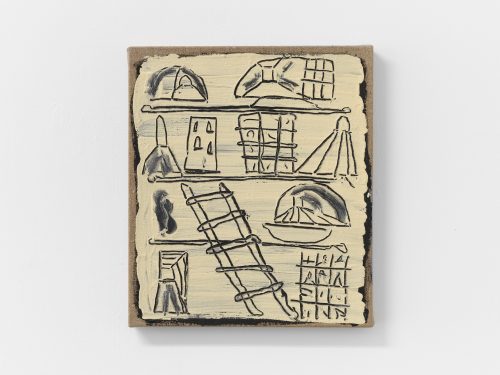
Hollow Bones 9, 2025, silk, cherry wood, oil sticks, ink, 85 x 92 x 4.5 cm

Hollow Bones, 2025, installation view

Hollow Bones, 2025, cherry wood, rope, 65x80x12cm

Hollow Bones 10, 2025, canvas, cherry wood, oil sticks, close up

Hollow Bones 2 and 3, 2025, silk, cherry wood, oil sticks, ink, 31 x 70 x 4.5 cm, cherry wood, oil sticks, ink.

Hollow Bones 10, 2025, canvas, wild cherry wood, oil sticks, ink, 85 x 130 x 4.5 cm

Hollow Bones, 2025, installation view

Regulus Regulus, 2025, close up

Hollow Bones, 2025, installation view

Hollow Bones, 2025, installation view

Dino, 2025 Glass wax, liquid ceramics and pigment. 37 x 21 x 26 cm

Ghost Note III, 2024 Ceramic and pigments 153 x 99 x 4 cm

Ghost Note II, 2024 Ceramic and pigments 200 x 150 x 4 cm

Regulus Regulus, 2025, installation view

Regulus Regulus, 2025, close up

Regulus Regulus, 2025, close up

Platalea Ajaja, 2025, canvas, cherry wood, oil sticks, ink, installatino view
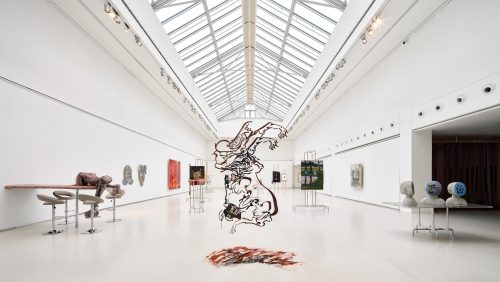
Inspired by the anatomy, behavior, and poetry of birds, Barandun transforms the gallery into a delicate forest of forms, a place where flight, stillness, and memory coexist. The works explore how birds move, nest, migrate, and inhabit the world, yet the exhibition is not about ornithology. Instead, it unfolds as a visual composition, a polyphonic installation where gestures echo, shapes vibrate, and silence becomes part of the work. The exhibition brings together ceramic reliefs, hand-carved wooden sculptures, drawings, and large suspended paintings that float in the space like fragments of a musical score.
MARC BIBILONI gallery presents Hollow Bones, an exhibition by Swiss artist Bianca Barandun (b. 1984), curated by Kosme de Barañano y Letamendía. The title of the exhibition refers to the hollow bones of birds, light, air-filled structures that paradoxically give them the strength to fly. From this image, Barandun builds a reflection on fragility as a source of balance, and on the capacity of the body and matter to contain the invisible.
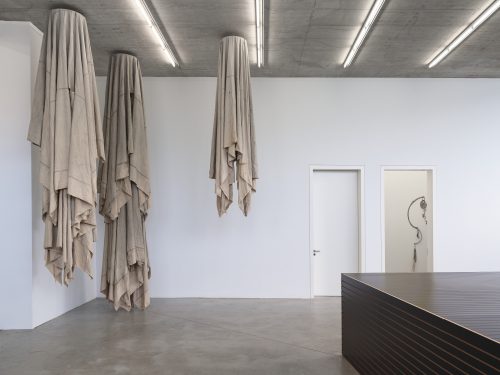
The exhibition presents an ambitious ensemble of a wide range of materials creating an immersive environment that envelops the viewer in a silent yet vibrant atmosphere. The works are arranged in the space as a self- contained ecosystem, where forms evoke the rhythm of flight, the resonance of song, and the natural architecture of nests. Each piece emerges from a dialogue between careful observation and intuition. In her ceramic reliefs—created through a three-dimensional printing process using relief printing processes, silicone molds and pigmented liquid ceramic, the artist explores the relationship between gesture and surface, between line and volume. In her hand-carved wooden sculptures, matter takes on an almost organic character: suspended bodies, structures that recall feathers, branches, or shelters, seeming to lighten their weight to become part of the air itself. Inspired by the yellow weaver bird, which builds its nest suspended from a tree branch and made of long strips of woven grass, the suspended paintings, connected by yellow threads, can be turned, reversed, and rehung, inviting viewers to perceive them as living forms that shift between drawing, painting, and sculpture. This sense of flight, variation, and polyphony runs through the entire installation. Barandun’s work is shaped by an intuitive dialogue between line, colour, and form. Birds appear not as literal motifs, but as presences, as rhythms, movements, and architectures of air. Their gestures, fragility, and silent ways of inhabiting space become the invisible grammar of the exhibition.
Hollow Bones offers an immersive journey where technical precision meets profound spirituality. The artist invites the viewer to listen with their eyes, to perceive the presence of air, and to discover the strength contained in lightness. Her work reminds us that what is essential is not always visible, but rather found in the breath that unites all things.
Bianca Barandun practice spans sculpture, installation, and drawing, exploring the connections between materiality, rhythm, and perception.
Through a poetic yet rigorous approach, the movements of the natural world are transformed into formal structures that oscillate between the organic and the architectural. In her practice, Barandun combines ceramic technique, wood carving, and drawing to create sculptural environments that transcend the notion of the object. Each exhibition is conceived as a total installation, a space of contemplation where matter and air engage in precise equilibrium.
About the Artist
Bianca Barandun (b. 1984, Switzerland) lives and works between Switzerland and Germany. A graduate of the Royal College of Art in London, Barandun has built a strong international career. Her work has been shown at institutions such as the Bündner Kunstmuseum Chur, Kunsthalle Ziegelhütte in Appenzell, Kunsthaus Glarus, NRW-Forum Düsseldorf, MK Gallery in Milton Keynes and Kunsthal Charlottenborg in Copenhagen, among others. It has been featured in specialized art publications and collected by private institutions in Switzerland.
About the Curator
Kosme de Barañano y Letamendía (Bilbao, 1957) is an art historian, curator, and scholar. He has served as Director of the Instituto Valenciano de Arte Moderno (IVAM), Deputy Director of the Museo Reina Sofía, and Curator of the Venice Biennale. A professor in universities across Spain, Germany, and Italy, Barañano is the author of numerous essays on modern and contemporary art and has curated exhibitions of artists such as Eduardo Chillida, Alberto Giacometti, Georg Baselitz, Antonio Saura, and Jannis Kounellis, among others. In Hollow Bones, he offers a critical reading of Barandun’s work, interpreting her sculptures as forms of material thought, where emptiness becomes a structural element and lightness acquires a spiritual dimension.
Marc Bibiloni Gallery