Tadeáš Podracký
It Grows With You
Project Info
- 💙 MeetFactory, Prague
- 💚 Ján Gajdušek
- 🖤 Tadeáš Podracký
- 💜 Ján Gajdušek
- 💛 Eva Rybářová
Share on

It Grows With You, 2026, exhibition view, MeetFactory
Advertisement


Armchair (series The Metamorphosis), 2021; Mirror, 2023; exhibition view from It Grows With You, 2026, MeetFactory

Armchair (series The Metamorphosis, detail), 2021; Mirror (series Fading Re ection), 2023; exhibition view from It Grows With You, 2026, MeetFactory

Mirror (series Fading Re ection), 2023; exhibition view from It Grows With You, 2026, MeetFactory

It Grows With You, 2026, exhibition view, MeetFactory

It Grows With You, 2026, exhibition view, MeetFactory

Tree of Otherness, 2023; exhibition view from It Grows With You, 2026, MeetFactory

Floor lamp (series The Metamorphosis), 2021; exhibition view from It Grows With You, 2026, MeetFactory

Sprouting bone, 2023; exhibition view from It Grows With You, 2026, MeetFactory

It Grows With You, 2026, exhibition view, MeetFactory

Bark and Veins, 2023; exhibition view from It Grows With You, 2026, MeetFactory

It Grows With You, 2026, exhibition view, MeetFactory

The Bloom of Bones Mirror, 2024; exhibition view from It Grows With You, 2026, MeetFactory

Thistle, 2023; Bark and Veins, 2023; exhibition view from It Grows With You, 2026, MeetFactory

It Grows With You, 2026, exhibition view, MeetFactory

Fertile Seed II (left), 2025; Fertile Seed I (right), 2025; exhibition view from It Grows With You, 2026, MeetFactory

Self-pollinating graft, 2025; exhibition view from It Grows With You, 2026, MeetFactory

Germinating Split, 2026; exhibition view from It Grows With You, 2026, MeetFactory

It Grows With You, 2026, exhibition view, MeetFactory

It Grows With You, 2026, exhibition view, MeetFactory
The exhibition It Grows With You presents Tadeáš Podracký as an artist who draws on the archetypes of functional objects yet uses them primarily as tools for recalibrating perception. Working for years on the threshold between design and fine art, Podracký retains the recognisable “skeletons” of chairs, armchairs, mirrors, chaise longues, or light fixtures, while deliberately disrupting the functions viewers expect them to perform.
The point of departure for Podracký’s Metamorphosis series is the gesture of “turning inside out” – not as a mere formal transformation, but as a method that overturns the relationship between structure, function, and ornament. The artist builds on the archetype of the modernist object (the series begins with Podracký’s chair whose form is derived from Gerrit Rietveld’s iconic Red and Blue Chair from 1918), preserving its internal minimalist logic as a legible framework. He then intentionally “inverts” this framework, tipping it into maximalism in favour of fluid, eruptive decorativeness, bodily performativity, and an energy that the modernist model typically suppresses by definition. A comparable logic of role reversal appears in details and materials: in the case of a mirror, for instance, Podracký employs techniques of ageing and decomposing the reflective layer to produce a deliberately distorted reflection.
In the subsequent series Morana, the artist shifts toward working exclusively with solid wood, tracing how folk rituals rooted in pagan and Christian traditions are transformed when transplanted into an urban environment shaped by an extreme material culture. At the centre of the series is a sculptural relief of Morana, the personification of death, depicted as a skeleton that is reborn and overgrown with human and floral details.
From his engagement with folk rituals, Podracký moves toward a deeper study of specific tree species and a growing interest in landscape and the memory of place. A key motif in his current phase is the Sudeten rowan (Sorbus sudetica) – an extremely local endemic to the Krkonoše Mountains that emerged as a hybrid plant after the last Ice Age. Podracký is fascinated by its microlocal existence (only around 150 living specimens have been documented today) as well as by the temporal depth of place-memory the rowan carries within it.
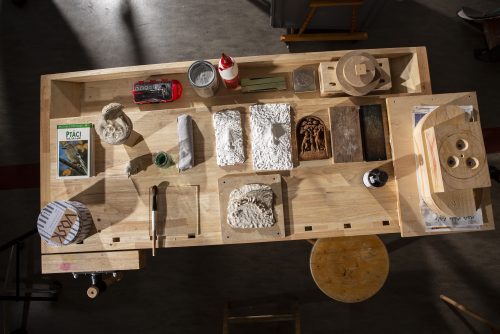
A major shift in Podracký’s recent work lies in the coupling of intensive handcraft with digital modelling and robotic production. Conceptually, this is not a departure from his established approach, but a continuation of the principle of hybridisation applied to the level of making – from a hand sketch and digital modelling through rough milling by a CNC robot and subsequent hand carving of the final details. He uses 3D-printed models as a kind of map, analogous to historical sculptural methods based on maquettes and transfer aids. The exhibition therefore also includes an experiment with 3D printing in wood filament – primarily a test of limits: to what extent a printed object can still be meaningfully transformed by manual intervention, and at what point material and technology begin to impose constraints on authorial authenticity.
Podracký’s earlier and ongoing inspiration from J. G. Ballard’s 1962 short story The Thousand Dreams of Stellavista offers an incisive reference point for his thinking about the mutability of objects. In Ballard’s tale, a psychotropic house responds to its inhabitants, rewriting its interior layout according to the moods of both current and past tenants. Similarly, Podracký’s objects behave as sensitive hybrid systems: they carry the cultural genealogies of modernism, ritual practices, and material traditions, while simultaneously inverting them and compelling us to think differently about their form and content.
The title It Grows With You thus describes not only the process by which the exhibited works come into being, but also the exhibition architecture itself. The spatial design loosely echoes Ballard’s vision of an interior that deviates from the norm – for example, a tilted wall in one of the rooms alters bodily orientation and the reading of spatial stability. The exhibition does not merely provide a backdrop for objects; it creates a situation in which Podracký’s hybrid method becomes a spatial experience, and in which the works and the architecture figuratively “grow” together with the viewer.
Tadeáš Podracký (*1989) graduated from the Academy of Arts, Architecture and Design in Prague, where he studied in the Glass Studio, and from the Contextual Design department led by Louise Schouwenberg at the Design Academy Eindhoven in the Netherlands. He completed artist residencies at the School of Visual Arts in New York and at the Academy of Fine Arts in Prague. His work has been exhibited, among others, at the Nieuwe Instituut in Rotterdam, mudac—Museum of Contemporary Design and Applied Arts in Lausanne, the Triennale in Milan, and at international fairs including Design Miami, TEFAF Maastricht, FOG, and Art Cologne. He is represented by Barcelona-based Side Gallery, Sarah Myerscough Gallery in London, and has collaborated in the Czech Republic with Polansky Gallery. Since 2023, he has served as Head of the K.O.V. Studio (Concept–Object–Meaning) at the Academy of Arts, Architecture and Design in Prague.
Ján Gajdušek