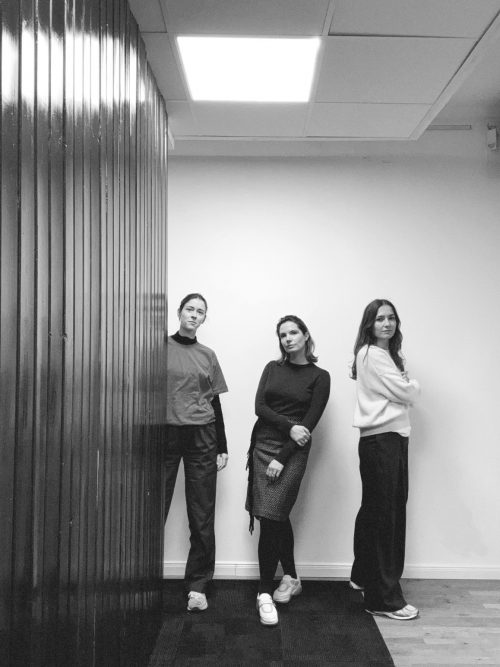
Daniel von Bothmer, Živa Drvarič, Monika Grabuschnigg, Jieun Lim, Miriam Steinmacher, Daniel Stubenvoll
Funny Weatheer

Installation view, Funny Weather, 2026, GOODBANK, Frankfurt am Main
Advertisement


Installation view, Funny Weather, 2026, GOODBANK, Frankfurt am Main

Installation view, Funny Weather, 2026, GOODBANK, Frankfurt am Main

Installation view, Funny Weather, 2026, GOODBANK, Frankfurt am Main

Installation view, Funny Weather, 2026, GOODBANK, Frankfurt am Main

Installation view, Funny Weather, 2026, GOODBANK, Frankfurt am Main

Monika Grabuschnigg, Cold Storage (Thrice), 2025, glazed ceramic, 48 x 36 x 8 cm

Daniel Stubenvoll, conversation starter (my left hands dream of time for us all), ca. 1980/2026, Vintage Seiko Unisex Watch, Steel Case, Custom Enamel Painted Dial, 22 x 26 mm, Manual Wind, Original Steel Stretch Bracelet

Daniel Stubenvoll, conversation starter (my left hands dream of time for us all), ca. 1980/2026, Vintage Seiko Unisex Watch, Steel Case, Custom Enamel Painted Dial, 22 x 26 mm, Manual Wind, Original Steel Stretch Bracelet

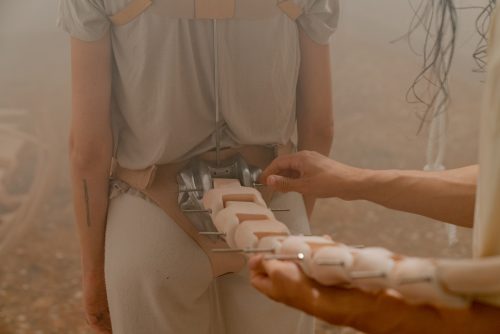
Živa Drvarič, Outfit I, 2026, Acrylic, Aluminium, Cashmere, Cotton, Polyester, Waxed cotton cord, 37 x 19 x 3 cm

Daniel von Bothmer, nachRichten, 2025, Glazed ceramic, 14 x 20 cm

Miriam Steinmacher, softskills, 2018, Fake leather, office chair, wood, upholstery Dimensions variable

Jieun Lim, Method(act), 2024, Digital print 35 x 29 cm, Edition of 3 + 1 AP
In GOODBANK’s final exhibition, 'Funny Weather' traces how art might offer encouragement in light of today’s social global developments. Across the show, displaying works by Daniel von Bothmer, Živa Drvarič, Monika Grabuschnigg, Jieun Lim, Miriam Steinmacher and Daniel Stubenvoll, the effects of this breach seem to register unevenly: some works push towards radical implication, while others withdraw socially. What coheres is a tonal field—one shaped by introspection, where solitude and melancholy sit alongside strategies of self-protection, even as moments of quiet, subversive resistance begin to surface.
'Funny Weather' lends the exhibition title as an homage to Olivia Laing and her same named essay collection in which art is described as a practice that makes social tensions visible without resolving them. Within a social order that privileges adaptation, efficiency and emotional restraint, gestures of care or compassion appear less as certainties than as fragile and situational acts. Amid social change, people respond to this reality in different ways: in everyday life, in offices and in the small routines that structure daily experience.
In Monika Grabuschnigg’s series 'Cold Storage' (2023–ongoing), the artist recreates the doors of mini-bar refrigerators found in hotel rooms. Like their real-life counterparts, the ceramic reliefs like 'Cold Storage (Thrice)' (2025) contain fleeting traces of human presence: for a brief moment, they preserve the memories, longings and personal belongings of their temporary occupants.
So-called soft skills refer to interpersonal competencies—the abilities that shape how we relate to—and especially work with others. Miriam Steinmacher’s work, bearing this title 'softskills' (2018), fake leather composition based on five suit patterns appears to imitate an office chair yet fails in its function. The piece resists office compatibility; a humorous refusal against utility and the demand to perform.
Today, a wristwatch is a symbol with multiple meanings. It can signal status and, within insider circles, becomes an object of absolute luxury or a device to track performances above anything else. Ultimately, a watch reveals more about its wearer than its value or additional functions might suggest. Daniel Stubenvoll’s installation of 'Conversation starter (my left hands dream of time for us all)' (2026) functions as a silent yet powerful device, transmitting ethical and political signals to the viewer, when familiar with the codes.
Gestural codes such as the collapsed hands over one’s face as a sign for despair, or even crying are questioned with the serial photo print 'Method(Act)' (2024) by Jieun Lim. Imitation or real vulnerability, compassion spreads hesitantly, given the title. A torn position, reminiscent of today’s realities and imminent feedback culture.
The art of Daniel von Bothmer is anything but restrained or quiet. The German flag, inscribed with the artwork’s title 'nachRichten' (2025) radiates intensely and confronts us directly with its heavy historical burden. More urgently than ever, both political and social attitudes must be critically questioned today, omnipresent in the newspaper and on accelerating social media channels.
The delicate folds in Živa Drvarič’s textile wall work 'Outfit I' (2026) evoke clothing as much as curtains or blinds—elements that share a similar function: protection, even disguise. Drvarič’s practice often explores the interplay between the visible and the invisible, between the individual and the collective.
Throughout the exhibition, the ordinary and the unexpected intertwine: objects are liberated from their original function and become protagonists in a carefully composed play that mirrors our everyday lives and habits. Taking the subtitle 'Art in the State of an Emergency' from Laing’s essay, which feels particularly relevant today, the presented works offer—while never limited to this reading—forms of quiet resistance as well as comfort, make visible moments of both loneliness and hope.
Maja Lisewski, Gioia Mattner