Alison Flora & Anna Christen
Verschlossen

installation view
Advertisement


installation view

Anna Christen, As Long As It’s Polite,
2026, Wood, Rye straw, Printed paper

Anna Christen, As Long As It’s Polite,
2026, Wood, Rye straw, Printed paper

Anna Christen, As Long As It’s Polite,
2026, Wood, Rye straw, Printed paperAnna Christen, As Long As It’s Polite,
2026, Wood, Rye straw, Printed paper

installation view

Alison Flora, Le vent des songes, 2023, Human blood on paper, lead frame

Alison Flora, Le vent des songes, 2023, Human blood on paper, lead frame

Alison Flora, Sanctuaire étoilé, 2023, Human blood on paper, lead frame

Alison Flora, Sanctuaire étoilé, 2023, Human blood on paper, lead frame

Alison Flora, La chute, 2025, Human blood on canvas

Alison Flora, La chute, 2025, Human blood on canvas

Alison Flora, La chute, 2025, Human blood on canvas

Anna Christen, As Long As It’s Polite,
2026, Wood, Rye straw, Printed paper

Anna Christen, As Long As It’s Polite,
2026, Wood, Rye straw, Printed paper

Anna Christen, As Long As It’s Polite,
2026, Wood, Rye straw, Printed paper

Anna Christen, As Long As It’s Polite,
2026, Wood, Rye straw, Printed paper
Grotesque figures run across checkered floors. Dice fall and the rye straw rustles. Inlays gleam and adorn the wood. The grain resembles the structure of veins, carrying the blood through our bodies. The corpus reflects our actions. Things are enclosed within: letters in secret compartments, dreams in the night. Foldable and expandable, one writes on these fabulous surfaces, applies makeup in their mirrors, shares and communicates. An interior turned inside out, integrated into everyday life, protected by coiled springs and hidden through secret compartments.
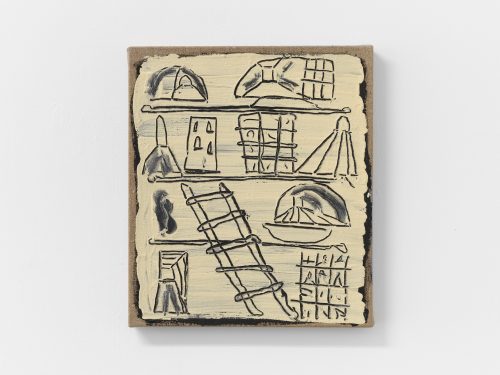
Alison Flora paints with her own blood, following a precisely defined protocol that resembles a ritual. The paintings created with this highly charged, symbolic medium reveal a fascination with surreal scenes. Flora draws her inspiration from medieval imagery, alternative cultures, and occult as well as esoteric worlds. She exorcises her fears and obsessions through a dramatically absurd universe in a form of ritualized therapy, placing mystical female figures at the center as protagonists. These works, reflecting her intimate thoughts, resonate in a time when we are reconsidering the role of women in history.
In her objects, Anna Christen explores how design can carry intimacy and secrets. The object seduces or conditions the user into an action without fully determining it. In the style of traditional marquetry and influenced by Abraham Roentgen’s transformation tables, Christen creates straw inlays that continually shift into various dimensions. The exploration of the performative aspects of furniture raises questions about the staged quality of interactions with these objects: What happens when an object can move, or when a specific action is suggested by a piece of furniture? Hidden numbers hint at a concealed numerical order, while a sloped surface gently tilts.
Bene Andrist