Madelen Isa Lindgren @madelenisa
TO ALL THE SPROUTS THAT CHANT AT NIGHT
Project Info
- 💙 Spjeld @spjeld_oslo
- 💚 Mari kanter & Max Barel
- 🖤 Madelen Isa Lindgren @madelenisa
- 💜 Marthe Yung Mee Hansen @martheyungmee
- 💛 Max Barel @max_barel
Share on

Advertisement


To All the Sprouts That Chant at Night
[...] and so I listen to the electricity of the vibrations, the last substratum of reality’s realm,
and the world trembles inside my hands.
Clarice Lispector, Água Viva, 1973
How do protection and resistance take form in vulnerable processes? Change is inevitable, but we can ask ourselves how we respond when cycles older than timekeeping itself continue to be put under pressure by ideologies of accumulation and expanded control.
Madelen Isa Lindgren approaches going forward by looking towards aspects of the past. She explores how Earth’s recurrent shifts can be understood as value systems that we once were more in tune with. Her studies of transitional phases in both nature and culture are brought into her sculptures, where they are materially processed. She refers to them as part of locating where one is in the landscape of time.
Throughout the centuries, maps and coins have been used as tools in missions of territorial control and capitalistic trade. In the hands of Ursula K. Le Guin and Lindgren, such entities instead become vessels—or carrier bags—containing philosophies that preserve knowledge from the past and advocate for a cosmic order focused on sustaining rather than advancing at all costs. The maps and amuletic works use a speculative cartography, serving as inventions of alternative realities through which we can imagine how current worldviews may be reformed, changed, or even replaced.
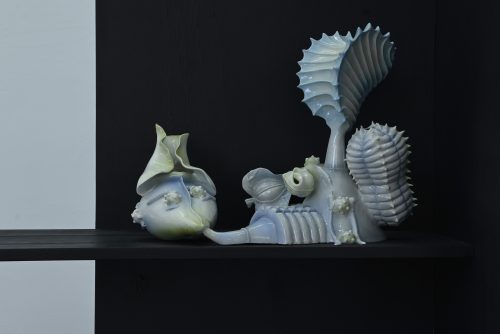
In To All the Sprouts That Chant at Night, the artist dives into a new branch in her exploration of how value is defined and how this in turn manifests itself materially. In the sculptural scenography presented, sprouts of glass are seemingly stretching towards the sky. Lindgren has rendered the seedlings in a liminal phase—no longer seeds lying protected by the earth, not yet bloomed into maturity.
The fragility of the sprouts is portrayed through glass as they grow from dark soil, represented as circles of leather—a material inherently intimate. Strands flow out from beneath them, like roots, tentacles, or fungal hyphae, reaching toward one another and intertwining.
Closely linked to the spatial works are the artist’s coin-shaped amulets. Through the study of small carriers of iconography and symbols, Lindgren draws inspiration from alternative cosmologies and rituals where material and immaterial realms intertwine through spiritual connection. In this sense, she approaches the coin or amulet similarly to how Le Guin used what she called talismanic maps—as symbolic, powerful vessels.
In the above quote from Clarice Lispector’s Água Viva, the narrator describes listening to music by resting her hand on a record player. The vibrations travel through her body, creating a sense of the world trembling in her hands. Throughout the novel, the narrator attempts—often struggles—to capture the experience of being: fluid, shifting, and continuously transforming.
Letting go of linearity and accepting this vastness may help ground us in time and place, welcoming a sensory attentiveness to our surroundings. Just as sonic vibrations anchor Lispector’s narrator, Le Guin’s people of the Valley locate themselves in time through talismanic maps. Similarly, Lindgren’s sculptural journal connects the material and corporeal to the historical, cosmological, and spiritual.
She encourages us to listen for the chants of our surroundings, so that we, too, may feel the trembles of the world.
Marthe Yung Mee Hansen @martheyungmee