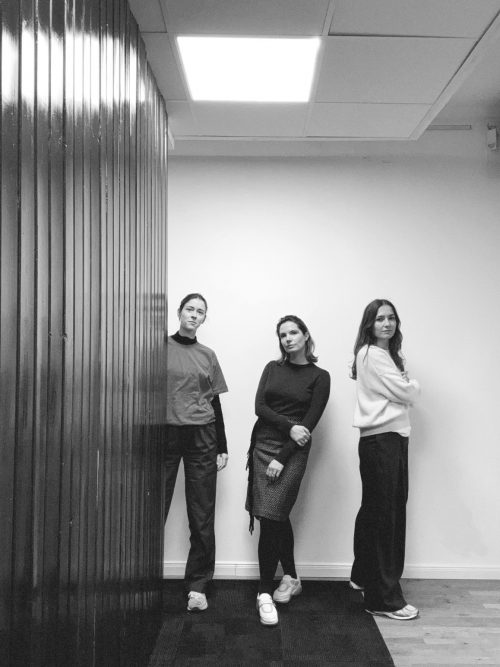
Emmanuel Beguinot, Nikita Gale, Keta Gavasheli, Brett Ginsburg, Gordon Matta-Clark, Erwan Sene, Leyla Yenirce
As the veneer of democracy starts to fade
Project Info
- 💙 Galerie Derouillon
- 💚 Clément Caballero
- 🖤 Emmanuel Beguinot, Nikita Gale, Keta Gavasheli, Brett Ginsburg, Gordon Matta-Clark, Erwan Sene, Leyla Yenirce
- 💜 Clément Caballero
- 💛 Gregory Copitet
Share on

"As the veneer of democracy starts to fade", curator Clément Caballero, with Emmanuel Beguinot, Nikita Gale, Keta Gavasheli, Brett Ginsburg, Gordon Matta-Clark, Erwan Sene, Leyla Yenirce, Derouillon, 2026 Courtesy of the artists and Derouillon Paris
Advertisement


"As the veneer of democracy starts to fade", curator Clément Caballero, with Emmanuel Beguinot, Nikita Gale, Keta Gavasheli, Brett Ginsburg, Gordon Matta-Clark, Erwan Sene, Leyla Yenirce, Derouillon, 2026 Courtesy of the artists and Derouillon Paris

"As the veneer of democracy starts to fade", curator Clément Caballero, with Emmanuel Beguinot, Nikita Gale, Keta Gavasheli, Brett Ginsburg, Gordon Matta-Clark, Erwan Sene, Leyla Yenirce, Derouillon, 2026 Courtesy of the artists and Derouillon Paris

"As the veneer of democracy starts to fade", curator Clément Caballero, with Emmanuel Beguinot, Nikita Gale, Keta Gavasheli, Brett Ginsburg, Gordon Matta-Clark, Erwan Sene, Leyla Yenirce, Derouillon, 2026 Courtesy of the artists and Derouillon Paris

"As the veneer of democracy starts to fade", curator Clément Caballero, with Emmanuel Beguinot, Nikita Gale, Keta Gavasheli, Brett Ginsburg, Gordon Matta-Clark, Erwan Sene, Leyla Yenirce, Derouillon, 2026 Courtesy of the artists and Derouillon Paris

"As the veneer of democracy starts to fade", curator Clément Caballero, with Emmanuel Beguinot, Nikita Gale, Keta Gavasheli, Brett Ginsburg, Gordon Matta-Clark, Erwan Sene, Leyla Yenirce, Derouillon, 2026 Courtesy of the artists and Derouillon Paris

"As the veneer of democracy starts to fade", curator Clément Caballero, with Emmanuel Beguinot, Nikita Gale, Keta Gavasheli, Brett Ginsburg, Gordon Matta-Clark, Erwan Sene, Leyla Yenirce, Derouillon, 2026 Courtesy of the artists and Derouillon Paris

"As the veneer of democracy starts to fade", curator Clément Caballero, with Emmanuel Beguinot, Nikita Gale, Keta Gavasheli, Brett Ginsburg, Gordon Matta-Clark, Erwan Sene, Leyla Yenirce, Derouillon, 2026 Courtesy of the artists and Derouillon Paris

"As the veneer of democracy starts to fade", curator Clément Caballero, with Emmanuel Beguinot, Nikita Gale, Keta Gavasheli, Brett Ginsburg, Gordon Matta-Clark, Erwan Sene, Leyla Yenirce, Derouillon, 2026 Courtesy of the artists and Derouillon Paris

"As the veneer of democracy starts to fade", curator Clément Caballero, with Emmanuel Beguinot, Nikita Gale, Keta Gavasheli, Brett Ginsburg, Gordon Matta-Clark, Erwan Sene, Leyla Yenirce, Derouillon, 2026 Courtesy of the artists and Derouillon Paris

"As the veneer of democracy starts to fade", curator Clément Caballero, with Emmanuel Beguinot, Nikita Gale, Keta Gavasheli, Brett Ginsburg, Gordon Matta-Clark, Erwan Sene, Leyla Yenirce, Derouillon, 2026 Courtesy of the artists and Derouillon Paris
Mark Stewart, "As the veneer of democracy starts to fade" 1985
As the veneer of democracy starts to fade
Some say the internment camp’s already built
It was one of those ambiguous days of rising tension
I remember drunks saying it could never happen here
As the more subtle forms of coercion proved ineffective
More and more sophisticated surveillance techniques are introduced
Subsonic and stroboscopic stun guns
The scavengers cannot take it much longer
As the small bands of interference realize they are totally unprepared for what lies ahead
Police computer banks linked to medical, financial, and political records
Magnetic card-carry as a means of identification
At the heart of the military-industrial complex the scavengers cannot take it much longer (…)
Taken from Mark Stewart’s 1985 album, "As the veneer of democracy starts to fade" evokes a democracy that does not disappear abruptly, but slowly crumbles from within, at its very foundations.
For a long time, cyberpunk fiction has embodied the fantasy of a dystopian urban landscape, where policies of population control extend from the design of cities to the manipulation of emotions through synesthetic devices. This fantasy finds an echo today in the real-world transformations of urban space, largely influenced by capitalist, military, and security logics, where power extends as it sees fit: the use of ultrasonic cannons, sirens, and loudspeakers in public spaces; low-altitude flights of subsonic aircraft; the humming of ventilation systems; the proliferation of electromagnetic waves from surveillance networks; and the sounds of demolition and construction marking the partitioning of certain zones or the tentacular expansion of urban planning.
These transformations profoundly alter the atmosphere of cities and, by extension, our sensory relationship to the built environment. A. N. Whitehead defines the “vibrational nexus” as the totality of ultrasonic and infrasonic frequencies that continuously influence sensory responses, placing the body in a state of constant tension with its environment. Sound and noise become central actors in the urban experience: they shape the affective tone of spaces and transform the conditions of perception. In this landscape, the military apparatus does not present itself as an external figure. It infiltrates urban systems, integrates itself, and camouflages itself within architectures. It operates from discreet spaces, where it becomes difficult to distinguish what pertains to the ordinary functioning of the city from what pertains to its logic of control (E. Sene). This shift produces an unstable environment, where vibratory flows play a central role. The urban fabric and its architecture/“anarchitecture*” are no longer content merely to shelter: they transmit, amplify, and affect.
The exhibition brings together a body of work that takes these transformations as its point of departure. Some pieces explore how memory and perception shape our relationship to places, revealing how these frameworks become fragile, and at times unstable, particularly in tense socio-political contexts (K. Gavasheli, L. Yenirce). Others shift language, sound, or architecture itself into states of matter where what was legible becomes a trace, a residue, or a vibration, where clarity dissolves into sub-perceptible forms (K. Gavasheli, N. Gale, G. Matta-Clark). Sculptures conceived in situ, meanwhile, focus on the very structures of the city and examine the nature of suburban areas, while functioning as an extension of the exhibition space (B. Ginsburg, E. Sene). Collectively, the works create a tension between biological, industrial, and political forms, and demonstrate how the built environment directly influences psychological states.
What emerges is not a homogeneous system, but an ambiance, an interactive and diffuse atmosphere, made up of frictions and instabilities, where living conditions and conditions of perception merge. To listen closely is to pay attention to the power dynamics that run through these territories. Their reconfiguration shapes an ecology of fear**, often a vector of stress and violence, revealing psychological gray zones—areas where dissociation and a lack of discernment can emerge (E. Beguinot). In this context, collective initiatives serve as anchor points from which bastions of psychological and physical resistance can form, both against institutions and against the changes that overwhelm, disorient, and weaken us.
*Anarchitecture, Gordon Matta Clark (1943-1978, États-Unis)
**Ecology of Fear: Los Angeles and the Imagination of Disaster, Mike Davis, 1998
Clément Caballero