Shinoh Nam
A Guide to the Interior for a House on Ambiguous Grounds

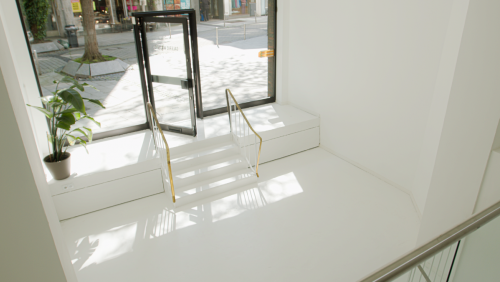
Shinoh Nam, A Guide to the Interior for a House on Ambiguous Grounds, installation view, ©Julie Becquart
Advertisement


Shinoh Nam, A Guide to the Interior for a House on Ambiguous Grounds, installation view, ©Julie Becquart

Shinoh Nam, A Guide to the Interior for a House on Ambiguous Grounds, installation view, ©Julie Becquart

Shinoh Nam, A Guide to the Interior for a House on Ambiguous Grounds, installation view, ©Julie Becquart

Shinoh Nam, A Guide to the Interior for a House on Ambiguous Grounds, installation view, ©Julie Becquart

For you who pray for yourself, for you who wait for the glory of salvation and victory at the end of suffering, I have a story I want to tell you. It is the kind of story you already know, 2026, 210 × 35 × 35 cm, ©StudioShinohNam

For you who pray for yourself, for you who wait for the glory of salvation and victory at the end of suffering, I have a story I want to tell you. It is the kind of story you already know, 2026, 210 × 35 × 35 cm, ©Julie Becquart

For you who pray for yourself, for you who wait for the glory of salvation and victory at the end of suffering, I have a story I want to tell you. It is the kind of story you already know, 2026, 210 × 35 × 35 cm, ©Julie Becquart

Detail view, ©Julie Becquart

Concept Drawings, Pen, black Japanese ink, oil pastel, acrylic paint, medium, inkjet print, Hahnemühle 300 g paper, 20 × 30 cm (28,5 × 38,5 × 3,5 cm framed), ©Julie Becquart

Is what we all actually want, in fact, to know each other deeply?, 2026, 225 × 34 × 26 cm, ©StudioShinohNam

Detail view, ©Julie Becquart

Is what we all actually want, in fact, to know each other deeply?, 2026, 225 × 34 × 26 cm, ©Julie Becquart

Doorknob: with every Doors, against my hopes and certainties (broken), 2025, Artist-polished steel, 14,4 × 4 × 8 cm, ©Julie Becquart

I No Longer Need to Hide Chocolate…, 2026, Artist-used 1900s furniture, polished cast aluminum, acrylic box, polished stainless steel, inkjet print, LED, and door viewer, 100 × 85 × 32 cm, ©Julie Becquart

Detail view, ©Julie Becquart

I love you. I will become me (Glass bead game and Demian by Hermann Hesse), 2026, Acrylic glass, hand-polished steel, stainless steel, books, 32 × 27 × 7 cm, ©Julie Becquart

The only thing I can do is stretch mean-inglessness until it shines, 2026, Antique furniture (used by the artist), polished cast aluminum, acrylic box, ash, and steel, 156 × 35 × 24 cm, ©Julie Becquart

Detail view, ©Julie Becquart

You, old and broken of limb, shall not break my world , 2026, Artist-made LC4 chair, stainless steel frame. cotton cord, polished cast aluminium, 85 × 90 × 74 cm, ©StudioShinohNam
For Gallery Weekend Berlin 2026, Mountains is pleased to present A Guide to the Interior for a House on Ambiguous Grounds, a solo exhibition by Shinoh Nam (b. 1993, Seoul, South Korea). Working across sculpture, installation, and spatial design, Nam's practice unfolds at the intersection of architecture and psychic analysis, tracing how material structures shape and destabilise subjectivity.
The exhibition takes the form of a fragmented house: its floor plan traced but never fully realised. Developed in collaboration with Berlin- and Seoul-based architect Changki Kim and drawing on the schematic staging of Dogville (2003), the installation presents an open interior through which visitors move freely. Within this exposed structure, boundaries collapse — between object and gesture, interior and exterior, observer and participant. Those outside may feel like voyeurs; those within, exhibitionists — or the reverse, as positions subtly shift.
Turning from architectural exteriors to interiors, Nam foregrounds furniture and domestic objects as vessels of ideology, bringing Victorian, Modernist, and Postmodern forms into uneasy coexistence. In 'You, old and broken of limb, shall not break my world'(all works 2026), dismembered elements of a Corbusier chair — one of the artist's recurring references — are reassembled into a fragile contortion, propped by a dented aluminium egg and bound with cotton thread. Elsewhere, desk-based works 'The only thing I can do is stretch meaninglessness until it shines', and 'I No Longer Need to Hide Chocolate…' resist easy categorisation, hovering between craft object and industrial remnant. Rather than narrating progress, these works expose how "good design" becomes institutionalised, aestheticised, and absorbed into systems of value and consumption.
Across the exhibition, hand-worked steel, burnt wood, and glass coalesce into structures that appear at once precise and precarious—fragments suspended between ruin and proposition. In Is what we all actually want, in fact, to know each other deeply?, a suspended, 360-degree rotating door segment evoking both interior and exterior faces — near-human in scale — is fitted with a casted aluminium eye and ear, positioned as if to see through a peephole or to eavesdrop. Surveillance here becomes reciprocal, intimate, and faintly absurd.
A second door work, 'For you who pray for yourself…', replaces solidity with transparency: a single panel forms the "lid" of an acrylic box. It is punctured by a letterbox through which a metal book has been dropped. Gesture hardens into symbol; communication becomes obstruction.
Finally, with 'Sang-ryang-mun (Topping-out ritual): For those who support my selfishness, I flare up and pray' (2026), constructed of charred wooden beams appropriated from a portion of the floor of an installation Nam exhibited last year, and embedded with sangnyangmun, a traditional Korean ceremonial text written and read when the main ridge beam of a building is being raised. Here, however, Nam has inverted this tradition.
Across A Guide to the Interior for a House on Ambiguous Grounds, Nam sustains a condition of structural and moral ambiguity. Rather than resolving these tensions, the exhibition inhabits them—suggesting that in the present moment, even clarity risks becoming another form of fiction.
Olamiju Fajemisin