Dew Kim
Sacrificium

exhibition view, Sacrificium
Advertisement


When All Flesh Turns to Light, 2026, Stainless steel, latex, vacuum cleaner, sensor timer, CNC-machined styrofoam, sex toy, mixed media, dimensions variable

When All Flesh Turns to Light, 2026, Stainless steel, latex, vacuum cleaner, sensor timer, CNC-machined styrofoam, sex toy, mixed media, dimensions variable

When All Flesh Turns to Light, 2026, Stainless steel, latex, vacuum cleaner, sensor timer, CNC-machined styrofoam, sex toy, mixed media, dimensions variable

When All Flesh Turns to Light, 2026, Stainless steel, latex, vacuum cleaner, sensor timer, CNC-machined styrofoam, sex toy, mixed media, dimensions variable

exhibition view, Sacrificium

exhibition view, Sacrificium

The Plant-Body and the Grief of Flesh, 2026, Lenticular print, CNC-machined birch plywood, 98×34×3cm

Apostles of the Sap, 2026, Stainless steel, brass casting, shower hose, mixed media, dimensions variable

Apostles of the Sap, 2026, Stainless steel, brass casting, shower hose, mixed media, dimensions variable

Apostles of the Sap, 2026, Stainless steel, brass casting, shower hose, mixed media, dimensions variable

Apostles of the Sap, 2026, Stainless steel, brass casting, shower hose, mixed media, dimensions variable

When the Gate of Eden Trembled, 2026, CNC-machined birch plywood, blown glass, metal chain, mixed media, 140×110×25cm

When the Gate of Eden Trembled, 2026, CNC-machined birch plywood, blown glass, metal chain, mixed media, 140×110×25cm

Flesh Becoming the Way, 2026, CNC-machined styrofoam, microcement, fabric, aluminum, resin, mixed media, 163×110×60cm

The Sap that Touched the Sky, 2026, Plaster casting, silicone, platinum-plated brass casting, beads, mixed media, 24×15×24cm

The Body that Remembers Itself, 2026, 3D printed PLA, aluminum casting, piercing, microcement, latex, heat shrink rubber, 42×30×16cm

The Body that Remembers Itself, 2026, 3D printed PLA, aluminum casting, piercing, microcement, latex, heat shrink rubber, 42×30×16cm

The Succulent Gospel, 2026, Artist book, offset print on paper, aluminum casting, 16.5×26 cm (Design: Minho Song. Commissioned by the Seoul Museum of Art for the exhibition AMOR EX MACHINA. Courtesy of Seoul Museum of Art)

The Succulent Gospel, 2026, Artist book, offset print on paper, aluminum casting, 16.5×26 cm (Design: Minho Song. Commissioned by the Seoul Museum of Art for the exhibition AMOR EX MACHINA. Courtesy of Seoul Museum of Art)
Annotations on Sacrificium
The Succulent Gospel tells us: In the beginning, there was a bone. It was a rib that had fallen from the first human, whose perfect body dwelled in an Eden overflowing with light. Excommunicated from that place where all things existed in harmony, the bone had no choice but to wander the outside, until it encountered a hole.¹ Dark and deep, a hole whose depths could not be known, a forgotten hole—the bone resolved to settle there. The hole took the bone in at once and immediately burst forth with a viscous liquid, a discharge, a sap. Was it pain? Or jouissance? (Were the two ever different?)
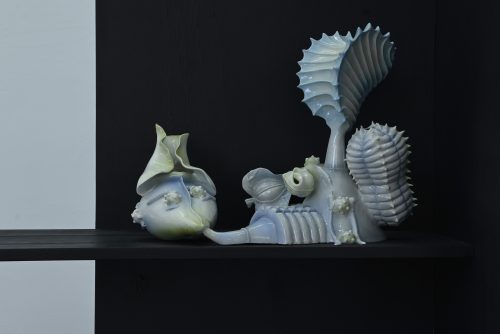
Dew Kim, author of the gospel, tells us that the fallen bone, the deep hole, and the overflowing sap clung together and gave birth to the Succulent (多肉). True to its name, the Succulent is both one and a bundle—a body in which multiple bodies entangle, overlap, and differentiate. These bodies pass through one another, seep into one another, and endlessly fold and unfold. At the end, yet another being is born: the disciples. To see what form they took when they manifested, follow the icons and pieces resonating with each chapter of the Gospel.
Dew Kim has long explored the ways bodies intersect and are performed within religious systems, sexuality, and sadomasochistic practices. This exhibition, Sacrificium, overlays the sites of ritual and desire, proposing an ethics of another dimension. Beginning from the 2018 solo exhibition Succulent Humans, which queerly appropriated the story of Adam and the rib in Genesis to unsettle gender binaries and hierarchies and to explore hybrid bodies, this exhibition radically expands that mythic narrative. Here, the origin of the world is not an individual entity but a succulent body formed through grafting and proliferation, and the form of these bodies piercing and entwining one another arrives as an aesthetic and ethical community.
In particular, within this space where the ritual site and the dungeon where BDSM play takes place strangely overlap, a rewritten Genesis and newly composed sacred images and hymns constitute a queer ethical system.² The first condition of this ethics lies in abandoning the belief in innocent and refined moral norms, in normative and safe relationships. Instead, it appears in the form of filling one another's holes, proliferating as bundles, and entwining one another in pleasure and pain, dependence and trust. And this readily exceeds the singular origin, the normal body, and heterosexual norms presupposed by religious systems, presenting itself as a structural condition that constitutes this transgressive world.
At the end of a narrow passage, in a space evoking an altar, When All Flesh Becomes Light unfolds on both sides. Though it sits as solemnly as a sacred image, unlike such images that function as signs conveying truth and spirituality, this large-scale work delivers anxiety and tension. Watching the latex's movement as it rhythmically squeezes the pipes, it seems more fitting to understand this in the extension of BDSM vacuum play, in which a player enters a bed that is then evacuated to vacuum state, leaving only a silhouette. Vacuum play, in restraining the body and controlling breath, may appear to reproduce social norms and hierarchies to an extreme degree. Yet this work treats vacuum play as a radical form of mutual dependence and care. Like SMers, who reach pleasure by finely sensing and attuning to each other's states, it reveals what lies most deeply within at the perfect moment, generating an immersion that surpasses tension. Thus this work, which operates through delicate attunement, goes beyond representations of sexual acts and orientations, leaving room to imagine radical care and practice, alternative communities and social fields.³
Meanwhile, such practice is once again concretely summoned, this time borrowing a religious form, in the structure that stands at the center of When All Flesh Becomes Light. Just as the primordial queer body was born by rewriting the Genesis narrative, religious norms, sadomasochistic practice, and the ethics of queer community are woven together as a kind of circuit—mirroring and being mirrored, inverting and being inverted—and cannot but exist through mutual reference. In this sense, this structure is a variant (異形) of the pipe organ, which was once able to connect to the heavens through sacred sound. Resembling the pipe organ—a traditional church instrument that adds radiance to divinity—it stands massively and upright, yet its form and sound betray expectation as a variant: pipes clinging to one another, congealed residues, bruised surfaces, colonies of rust and stains. Pipes welded flesh-to-flesh, at the end of a chain of meetings and partings, finally become a metaphor for a queer community in which all are entangled as one body. At the same time, this overlaps with succulent plants that birth new flesh from wounds and divide outward. These are all bodies that exist differently from those of the neoliberal system, where reproduction is structured through the union of male and female reproductive cells, the birth of a child, and the formation of the family. Not sexually reproduced descendants of a first human pair as origin, but deformed proliferations of origin, bodies that have forgotten their origin. This body transforms taboo into pleasure, pleasure into mutual implication, and further forms a community that sustains care, constituting (as Paul B. Preciado puts it) a "somatic communism." And this community continues to extend its wounded holes, creating passages for breath. Here, seething, panting, ragged breaths never cease.
Therefore, Sacrificium is both a sanctuary where stigmatized desires gather and the figure of an ethical community woven through the most radical care and mutual dependence. Here, from bodies that have undergone passion and from torn wounds, flesh and desire proliferate. Here, a single body opens, connects, and is endlessly reborn. As those sacred scenes, receive with joy the grace therein revealed. A very old ethics, an unending gospel, shall come.
¹ This hole is Adam's anus. As "the first organ to suffer privatization, removal from the social field," and as the body part "considered the filthiest and most abject," the anus holds power as a practical organ of resistance against heterocentric practices. Paul B. Preciado, Countersexual Manifesto, trans. Kevin Gerry Dunn (Columbia University Press, 2018), pp. 30–33.
² BDSM is an abbreviation for bondage, discipline, dominance and submission, and sadism and masochism. This practice explores sexual orientation, bodily pleasure, and emotional connection through various tools and acts. Those who practice BDSM play, which is premised on consent and trust, are called SMers, and the site where this play takes place is called a dungeon.
³ Margot Weiss, Techniques of Pleasure: BDSM and the Circuits of Sexuality (Duke University Press, 2012), p. 11.
Jiyul Fog (CR Collective assistant curator)
Jiyul Fog